Curriculum
At Deighton Gates Primary School, we believe that every child deserves an education that inspires, challenges and prepares them for a successful future. Our curriculum is built around our vision of Excellence for All, where Every Child Matters and Every Effort Counts.
We are proud to deliver the National Curriculum while providing a wide range of rich experiences that help children develop academically, socially and personally. From the moment children enter our school, we aim to nurture a love of learning, develop confidence and curiosity, and help every child achieve their full potential. Our curriculum has been designed with all learners in mind, ensuring that every child can access, enjoy and succeed in their education.
Our learning is underpinned by our school values:
- Compassionate - understanding others, showing kindness and making a positive contribution to our school and community.
- Ambitious - aiming high, taking pride in achievement and striving to be the very best we can be.
- Resilient - embracing challenge, learning from mistakes and persevering when things become difficult.
- Equal - celebrating diversity and ensuring everyone feels valued, included and able to succeed.
The GATES Curriculum
Our curriculum is shaped by five key principles known as our GATES Curriculum: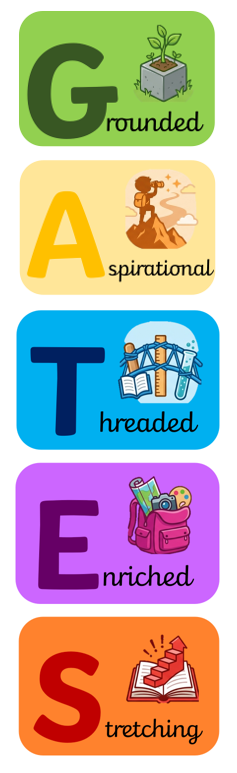
Grounded: We build strong foundations in knowledge, vocabulary and key skills so that children are confident and successful learners.
Aspirational: We encourage children to dream big, believe in themselves and recognise the opportunities available to them in the future.
Threaded: Learning is carefully connected across subjects and year groups, helping children make links and deepen their understanding over time.
Enriched: We bring learning to life through memorable experiences, educational visits, visitors, books, cultural opportunities and practical activities that broaden horizons.
Stretching: We challenge all children to think deeply, work hard and continually improve, helping them develop independence, resilience and confidence.
The Greats
The Greats are part of our GATES curriculum: we use significant people, texts, places and achievements as exemplars to enrich learning, build aspiration and deepen understanding. These are illustrative, not exhaustive -teachers draw on them when they best illuminate the curriculum, helping pupils connect what they learn to the wider world without adding unnecessary workload.
Learning Beyond the Classroom
We want our pupils to understand the wider world and see what is possible. Throughout their time at Deighton Gates, children encounter inspirational people, important places, significant events and high-quality texts that enrich their learning and raise aspirations.
Our curriculum is designed not only to help children achieve academic success, but also to develop the knowledge, skills, values and character they need to thrive in modern Britain and beyond.
We invite you to explore the subject pages below to find out more about what children learn at Deighton Gates Primary School and how our curriculum supports every child to flourish
The Foundation Stage Curriculum:
In Reception, we follow the Early Years Statutory Framework which focuses on the needs of children from birth to the end of the reception year. The curriculum for this stage has seven areas of learning. The Prime areas are: Communication and Language, Physical Development and Personal, Social and Emotional Development. The specific areas are Literacy, Mathematics, Understanding of the World and Expressive Arts and Design.
The Key Stage 1 and 2 Curriculum:
Our curriculum is based on the National Curriculum which sets out the statutory objectives for the knowledge, skills and understanding that we teach at Deighton Gates from Year 1 to Year 6.
Core Subjects: English, Maths and Science
Foundation Subjects: Art and Design, Computing, Design and Technology, French (KS2 only), Geography, History, Music, P.E,PSHE (Personal, Social, Health and Economic Education) and R.E. (for which we follow the Leeds agreed syllabus)